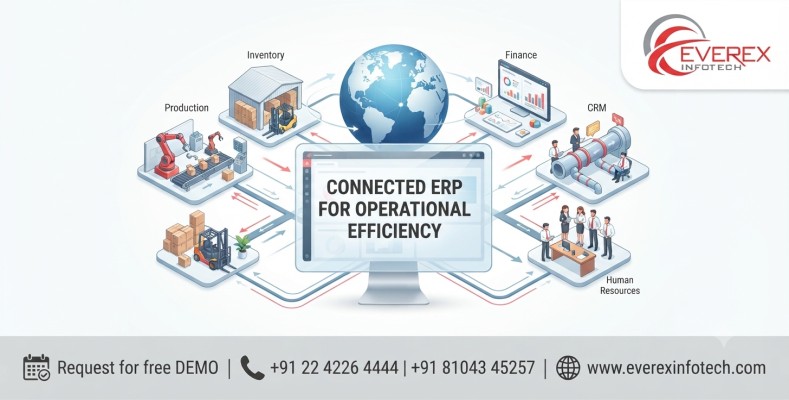
Large industries manage a wide network of business activities involving departments, locations, employees, suppliers, customers, inventory, finance, production, documentation, and service processes. As organizational complexity grows, maintaining separate systems or disconnected spreadsheets can make information difficult to coordinate.
The purpose of an enterprise business system is not simply to digitize individual tasks. It is to create a more connected flow of business information so that departments can work with consistent records and management can make decisions using accessible operational data.
Why do large industries need integrated business systems?
In a large organization, information is generated by many teams. Sales creates customer and order information. Procurement handles purchasing. Operations manage materials and fulfilment. Finance maintains accounting records. Human resources manages employee information.
When these functions are disconnected, employees may repeatedly enter the same data or depend on manual reconciliation.
ERP software for Large industries can address this challenge by providing a structured environment for managing interconnected business processes.
What does ERP actually mean?
ERP stands for Enterprise Resource Planning. In practical terms, an ERP system brings important business information and processes together within an organized software environment.
However, businesses should not select a system simply because it carries the ERP label. The solution must match the organization's actual processes, scale, and information requirements.
Everex Infotech develops enterprise software products covering areas such as ERP, inventory and financial management, export documentation, HRM, document management, and CRM.
How can connected information improve operations?
A connected system can reduce dependence on duplicate records. For example, when sales, purchasing, inventory, and finance information is maintained through related processes, employees can work with a more consistent view of transactions.
This can be particularly valuable for large industries where a single transaction may affect several departments. Instead of asking different teams for separate versions of the same information, authorized users can work from structured business records.
What should large organizations evaluate before choosing ERP?
The first question should be process fit. Companies should identify which operations need better coordination and where information currently becomes fragmented.
They should also consider reporting, user access, scalability, integration requirements, data quality, implementation support, and the ability to adapt workflows as business requirements change.
An ERP implementation should therefore be treated as an operational transformation project rather than simply a software purchase.
ERP software for Large industries becomes valuable when it helps an organization create better visibility across connected business activities. The objective is to reduce unnecessary manual work, improve access to current information, and support more consistent processes.
For organizations managing complex operations, the right ERP environment can provide a common foundation for business information. Instead of allowing every department to maintain its own version of reality, companies can move toward more connected workflows and clearer management visibility.
The most effective approach is to start with actual business requirements, map the processes that need coordination, and then select an ERP solution that can support those requirements without introducing unnecessary complexity.
Share Your Feedback
Thank you for visiting our website. We welcome your feedback, suggestions, and reviews. Your insights help us improve our products, services, and overall customer experience.