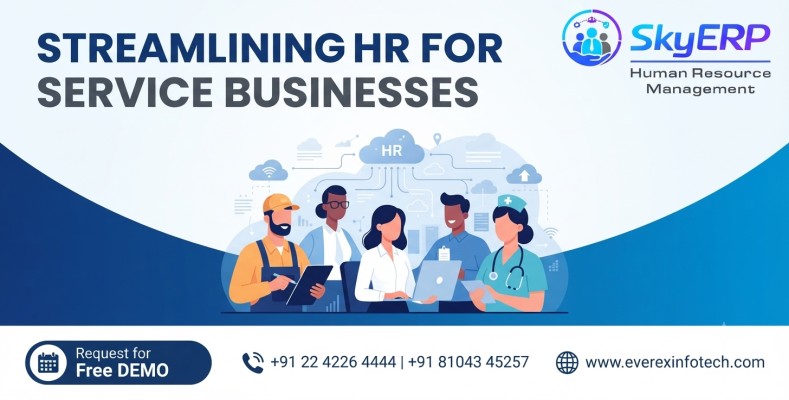
Service businesses depend heavily on people. Employees may work across offices, branches, customer locations, projects, shifts, or different departments. As the workforce grows, HR teams must manage employee information, attendance, leave, payroll, documents, and internal requests without allowing administrative work to become a burden.
Using spreadsheets and manual communication may work for a small team, but maintaining consistent records becomes increasingly difficult as employee numbers and HR activities increase.
What does employee management involve?
Employee management begins with maintaining accurate employee information. HR teams may need access to employee profiles, qualifications, previous work experience, departments, designations, pay grades, assets, transfers, and other records.
SkyERP HRM provides centralized employee information management with employee profiles, organizational structures, asset records, transfer tracking, and HR documentation templates.
For service organizations, Employee management software can provide a structured way to maintain these records instead of relying on multiple spreadsheets or physical files.
How can HR manage attendance and leave?
Service businesses often have employees working under different schedules. Some may work fixed shifts, while others may have different weekly offs or outdoor duties.
SkyERP HRM supports shift management, leave policies, multi-level approval workflows, attendance imports, work-from-home tracking, contractor tracking, and outdoor-duty tracking.
This can make HRM Software useful for service organizations where employee availability and attendance need to be monitored through defined policies.
Why is payroll integration important?
Payroll is one of the most important recurring HR processes. Manual calculations can require considerable checking, particularly when employee records, attendance, leave, deductions, and statutory requirements need to be considered together.
SkyERP HRM provides payroll functionality for Indian payroll and supports statutory components including PF, ESIC, TDS, PT, LWF, and bonus management.
Keeping HR information within a connected system can reduce the need to maintain separate employee and payroll records.
What about employee self-service?
Employees often contact HR for routine information such as leave balances, pay slips, attendance details, and request status. A self-service environment can reduce repetitive administrative communication.
SkyERP HRM provides employee-facing access for leave applications, request tracking, attendance, leave details, pay slips, Form 16, and company rules.
This can help service organizations create a more accessible HR experience while allowing HR teams to focus on higher-value activities.
How should service businesses choose HR software?
The best solution should match the organization's workforce structure and policies. Businesses should evaluate employee records, attendance, leave, payroll, reporting, compliance requirements, self-service, and scalability before selecting a system.
Employee management software should ultimately make employee information easier to maintain and access. HRM Software should also support consistent workflows rather than simply replacing paper forms with digital screens.
For service organizations, SkyERP HRM provides a centralized approach to employee management, attendance, leave, payroll, and HR administration.
By replacing fragmented HR processes with structured workflows, businesses can reduce repetitive administrative effort, improve information accessibility, and create a more organized foundation for managing their service workforce.
Share Your Feedback
Thank you for visiting our website. We welcome your feedback, suggestions, and reviews. Your insights help us improve our products, services, and overall customer experience.