For Indian entrepreneurs, the global market offers boundless opportunities. However, many potential exporters feel overwhelmed by the perceived complexity of paperwork. While international trade involves various compliance layers, understanding the structured flow of documentation can turn a daunting task into a manageable routine.
In this guide, we will break down the export documentation process in India and explore how modern technology can simplify your journey from local manufacturer to global supplier.
Understanding the Importance of Documentation
In international trade, documents are the "language" through which goods travel. They ensure that the exporter receives payment, the carrier knows how to handle the cargo, and the customs authorities can verify the legality of the shipment. Missing even a single signature can lead to shipment delays, heavy port fines, or payment failures.
Step-by-Step Export Documentation Process
1. The Pre-Shipment Stage
Before the goods leave your warehouse, you must establish the legal framework for the transaction.
- IEC (Importer Exporter Code): The first step for any Indian exporter is obtaining an IEC from the DGFT.
- Proforma Invoice: This is the initial document sent to the buyer, outlining the price, quantity, and specifications of the goods.
- Purchase Order: Once the buyer agrees, they issue a formal Purchase Order (PO).
- Sales Contract: A legally binding agreement that defines Incoterms (like FOB or CIF) and payment terms (like Letter of Credit).
2. Preparation of Commercial Documents
Once the order is ready, you must prepare the "Commercial Invoice" and the "Packing List." The commercial invoice for export is the primary document used for customs valuation. The Packing List details the contents of each individual package, including dimensions and weight.
3. Statutory and Regulatory Documents
In India, certain goods require specific certifications:
- Certificate of Origin: Proves that the goods were manufactured in India. This is often required for the buyer to claim preferential duty benefits.
- Inspection Certificate: Required for certain commodities to ensure quality standards are met.
- Phytosanitary or Health Certificates: Necessary for food, plants, or animal products.
4. Shipping and Customs Clearance
This is where the physical movement begins.
- Shipping Bill: This is the most critical document for Indian Customs. It is filed electronically via the ICEGATE portal.
- Bill of Lading (B/L) or Airway Bill: Issued by the carrier (shipping line or airline), this acts as a receipt for the cargo and a contract of carriage.
- Insurance Certificate: To protect the goods against risks during transit.
5. Post-Shipment and Bank Negotiation
After the ship departs, the exporter must submit the full set of documents to their bank to claim payment under the agreed terms. This includes the B/L, Commercial Invoice, and any Exchange Control Declaration (EDF) forms required by the RBI.
How Technology Simplifies the Process
Manually managing these dozens of forms is prone to human error. A single typo in a container number can halt a shipment for weeks. This is where specialized Export Documentation software becomes a game-changer for Indian businesses.
Introducing SkyERP Export Plus by Everex Infotech
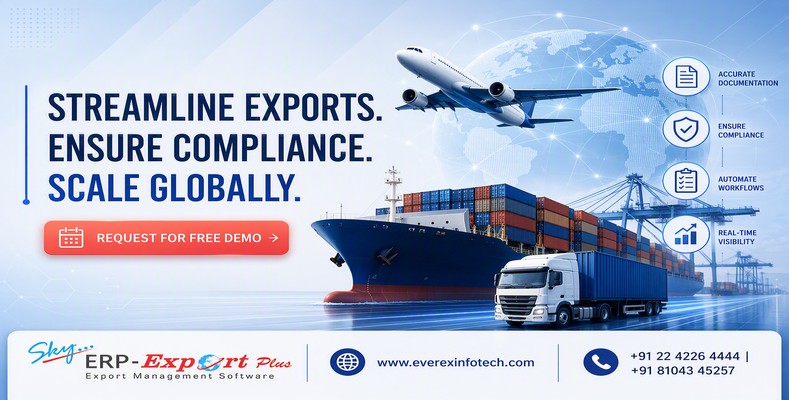
For exporters looking to scale, relying on Excel sheets and manual entries is no longer sustainable. SkyERP Export Plus, developed by Everex Infotech, is designed specifically to cater to the unique regulatory landscape of India. It integrates the entire workflow—from the initial inquiry to the final realization of payment—into a single, seamless platform.
Why SkyERP Export Plus is Perfect for Indian Exporters:
- Automated Document Generation: With SkyERP, you don't need to type the same data ten times. Once you enter the order details, the system automatically generates the Commercial Invoice, Packing List, Shipping Instructions, and Certificate of Origin. This use of specialized Export documentation software ensures 100% consistency across all documents.
- Compliance and Accuracy: The software is updated with the latest Indian Customs formats and GST requirements. This minimizes the risk of document rejection at the port or bank.
- Real-time Tracking: It allows exporters to track shipment statuses, container movements, and payment cycles, providing much-needed visibility into the supply chain.
- Cost Efficiency: By reducing the time spent on manual paperwork, your team can focus on finding new buyers and improving product quality, rather than getting bogged down in administrative tasks.
- Data Centralization: All historical data is stored securely. If you need to refer to a shipment from two years ago for an audit or a repeat order, it’s available at the click of a button.
Conclusion
Exporting from India is a prestigious and profitable venture, provided you master the "paper trail." While the documentation process involves multiple steps—from securing an IEC to negotiating bank documents—it doesn't have to be a struggle.
By adopting a robust Export Documentation software like SkyERP Export Plus, you can eliminate errors, save time, and ensure your business is compliant with international standards. As the world looks toward India as a global manufacturing hub, equipping your business with the right software is the best investment you can make to stay competitive.
To learn more about how you can digitize your export workflow, visit Everex Infotech and take the first step toward hassle-free global trade.
Share Your Feedback
Thank you for visiting our website. We welcome your feedback, suggestions, and reviews. Your insights help us improve our products, services, and overall customer experience.